


Table of contents
- Traditional automation
- Agentic and gen-AI automation
- The decision framework
- The hybrid pattern
- Examples
- Cost and reliability
- TL;DR: the quick decision
- Work with Weesho Lapara
- Additional resources
Every few weeks someone replaces a perfectly good docs pipeline with “an AI that writes the documentation,” and ends up with something slower, pricier, and less trustworthy than what they had. The reverse happens too: teams try to force a messy, language-heavy content task through rigid rules and spend months patching edge cases a model would have handled on its own.
The useful question isn’t “AI or automation.” It’s which kind of automation fits the job in front of you. And there’s a single test that sorts most documentation and content tasks cleanly: is the task the same every time it runs? If it is, you want deterministic, rule-based automation. If it isn’t, you’re in the territory where an LLM earns its cost. Most real documentation workflows need a bit of both.
Traditional automation
Traditional automation is deterministic. A trigger fires, a fixed sequence of actions runs, and the same input always produces the same output. In a documentation workflow this is your pipeline layer: CI/CD, static site generators, and reference generators that move content along predefined paths without anyone touching it.
Its strengths are exactly the things AI struggles with. It’s cheap and fast, with no model inference to pay for or wait on. It’s reliable and auditable: because the logic is fixed, inputs are structured, and the task doesn’t change. You can read it, test it, and know precisely what it will do, and when something breaks you can find the broken step. And it scales without surprises, behaving identically on the thousandth run as on the first.
Consider these examples:
- Vale as a GitHub Actions merge gate. Vale checks prose against a defined style ruleset and fails the PR if violations exceed a threshold. The input is text in a known format, the rules are explicit, and the correct output is binary: pass or fail. Reaching for an LLM to “judge” style here adds non-determinism to a process that should be mechanical. See the detailed walkthrough in our guide to Vale as a GitHub Actions merge gate.
- Triggering a publish on a Git push. A webhook fires, a build runs, content deploys. No language understanding required.
- Syncing a changelog field. Jira issue resolved, status written to a Notion database via n8n. Structured input, defined mapping, zero ambiguity.
- Routing a support ticket by label. If label equals “API docs”, assign to docs team. A lookup table, not a reasoning engine.
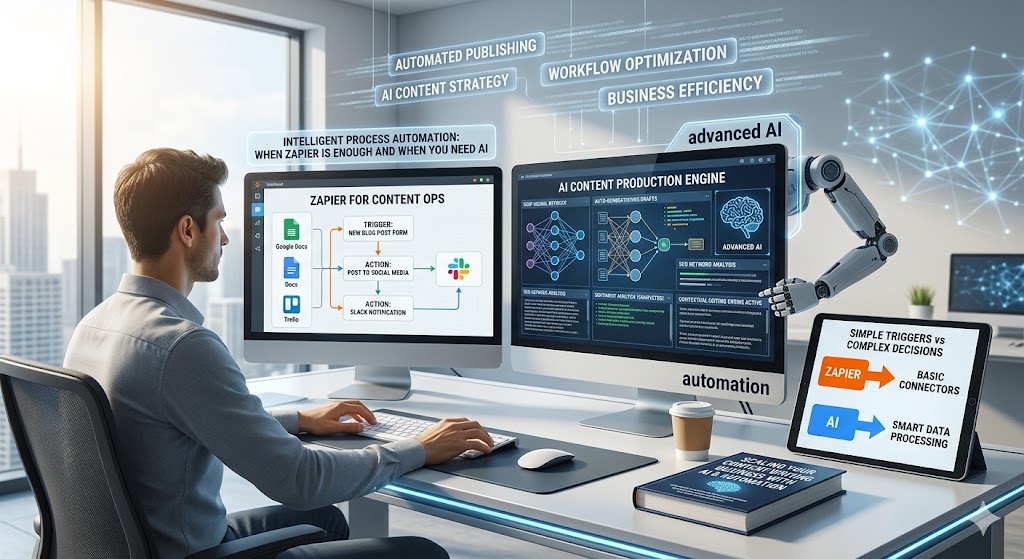
These are exactly the workflows Zapier, n8n, and Make were built for, and they handle them well. Using an LLM to route a ticket that already has a machine-readable label is like hiring a translator to read a barcode.
Agentic and gen-AI automation
Agentic automation, built on models like Claude, GPT, and Gemini, is good at the opposite kind of work. Instead of following fixed rules, the model interprets each input and decides what to do with it. This is what people increasingly mean by agentic process automation: automation that can handle judgment, not just steps.
For documentation and content, that unlocks tasks pipelines can’t touch: understanding source material (reading an engineer’s rough notes, commits or a support thread and grasping what the user actually needs to know), handling messy input (pulling the relevant facts out of a long product walkthrough transcript or understanding the intent behind the free-text in Jira description field ), and exercising judgment (drafting a plain-language explanation of a complex feature, or deciding which pages a product change affects).
But the power comes with real costs you have to design around. Every model call costs money and adds latency, which matters when you’re processing a lot of content. And critically, the output is non-deterministic: the same input can produce slightly different results, and the model can be confidently wrong. For documentation that’s a particular risk, because an inaccurate doc erodes user trust fast. So AI in a content workflow needs guardrails and, for anything you publish, a human checkpoint. You don’t get the “read it and know exactly what it does” guarantee that a pipeline gives you.
For documentation work connected to an API-adjacent content layer, it is worth understanding how structured specifications fit into this picture. Our post on multi-step API workflow documentation covers how Arazzo formalizes what would otherwise be implicit, which is a useful contrast to the freeform nature of agentic reasoning.
The dividing line is determinism
If a human expert would agree on the correct output every time, given the same input, write a rule. If correct output depends on interpreting meaning, use an LLM.
More specifically:
- Structured input + defined process = rule-based automation. The process belongs in Zapier, n8n, or a script. It will be faster, cheaper, and auditable.
- Unstructured input + judgment required = LLM reasoning. The task needs language understanding. Rule-based automation will fail on edge cases; an LLM handles them more gracefully.
- Mixed = hybrid. Fetch structured data deterministically, pass the unstructured parts to an LLM, then validate the output with deterministic checks before it goes anywhere.
A practical test: can you write the logic as an if/then that a room of five engineers would agree is complete and correct? If yes, automate it with rules. If the five engineers would spend twenty minutes arguing about edge cases and tone, you need an LLM.
The decision framework
Before reaching for either, run the task through these questions. The more a task leans one way, the clearer the choice.
| Question about the task | Points to rules (pipelines, generators) | Points to AI (Claude / GPT / Gemini) |
|---|---|---|
| Is it identical every run? | Yes | No, it varies by input |
| Is the input structured and predictable? | Yes | No, it’s messy notes or free text |
| Does it need to understand or write language? | No | Yes |
| Does it require judgment on ambiguous cases? | No | Yes |
| Is a wrong output costly or hard to catch? | Rules are safer (auditable) | Needs a human in the loop |
| Is it high-volume and cost-sensitive? | Rules win on cost | Watch per-call cost |
A task that’s “yes” down the left column is a pipeline job, and using AI for it adds cost and risk for nothing. A task that’s “yes” down the right is where a model genuinely earns its place. Most interesting documentation work lands in the middle, which is the whole point of the next section.
The content types that benefit most from automated production pipelines vary by how structured their source material is. Our guide to essential content types for every software business is a useful reference for mapping your content inventory against this table.
The hybrid pattern
Here’s what experienced builders converge on: the best documentation systems aren’t rules or AI. They’re a deterministic pipeline with a model dropped in at the one step that needs judgment.
Rules do what rules are good at: detecting what changed, fetching the source, validating, and publishing. The model does the single thing rules can’t: the understanding or the drafting. Everything around that step stays deterministic, cheap, and auditable, so you contain the non-determinism to exactly where it adds value and nowhere else.
Take automated release notes. A rules-based pipeline gathers the merged commits or closed issues since the last release, which is structured and deterministic. A model then drafts readable notes from that raw list, the one step requiring language and judgment. A human reviews and approves the draft, and rules publish it on merge. Four steps, and AI touches exactly one. The result is current, consistent documentation that costs a fraction of running a model over the whole process, with a human owning what actually ships.
That shape, deterministic rails with AI at the judgment point and human approval on anything that matters, is the pattern worth internalising. It’s how to get the capability of gen-AI in your documentation without inheriting all of its cost and unpredictability.
Examples
A few concrete documentation and content workflows, mapped to the framework:
- Pure rules: an API reference regenerated from your OpenAPI spec and republished on every merge. Structured input, identical every time, no interpretation. A model here would be pure waste, and worse, a source of avoidable errors.
- Pure AI: drafting a first-pass user guide or FAQ from a messy source, like a recorded product walkthrough or an engineer’s rough notes. The input is unstructured, the job is comprehension and rewriting, and a rough first draft a human then edits is exactly what you want.
- Hybrid: keeping docs in sync with the product. Rules detect what changed by diffing the OpenAPI spec or scanning merged pull requests, the model drafts updates for the affected pages, a human reviews them, and rules publish. The same shape works for content repurposing: rules pull a published article, the model drafts a newsletter or social version, a human edits, and rules schedule it.
The more a task depends on understanding or writing something, the further right it sits, and the most robust designs isolate that step and keep a human on the output.
Cost and reliability
One more thing worth saying plainly: just because AI can write a doc doesn’t mean it should write every doc. If a deterministic pipeline produces the reference reliably, choosing the cheaper, auditable, predictable path is the professional decision, not the unambitious one. Reserve the model for where its judgment is genuinely needed, wrap it in guardrails, and keep a human on anything customer-facing. Non-determinism is a feature when you need flexible drafting and a liability when you need a reference to be exactly right, and knowing which situation you’re in is most of the skill.
TL;DR: the quick decision
- Same every run, structured input, no interpretation, use a rule-based pipeline (CI, generators, link checkers).
- Needs to understand or write language, or handles messy source material, use AI (Claude, GPT, Gemini).
- Both, which is most documentation workflows, use a hybrid: deterministic rails, a model at the one step needing judgment, and a human approving what’s published.
If you’re deciding when to use AI in your documentation workflow, start by assuming rules until a step genuinely needs to read or write language. Add the model there, and only there.
Work with Weesho Lapara
Mapping out a documentation or content workflow and not sure which parts should be rules and which need a model? That hybrid line, a deterministic pipeline with AI at the judgment step and human approval on what ships, is exactly the kind of workflow we redesign and automate. Book a consult or get in touch, or see our documentation workflow and automation services.
Additional resources
- Docusaurus
- n8n
- Zapier
- Anthropic Engineering: Building effective agents, the clearest published distinction between workflows and agents, and when each pattern is appropriate.
- Zapier: AI automation grounds the no-code automation baseline and shows how the platform itself frames the boundary between rule-based steps and AI steps.
- Atlassian: Jira issue fields documentation documents the free-text nature of the summary and description fields referenced in the release-notes pipeline example.
- Anthropic: Prompt engineering overview covers how to constrain and validate LLM output, which is the basis for the hybrid pipeline’s validation layer.
- Gartner: Hyperautomation, the market definition of intelligent process automation as the combination of automation technologies applied where each is fit for purpose.